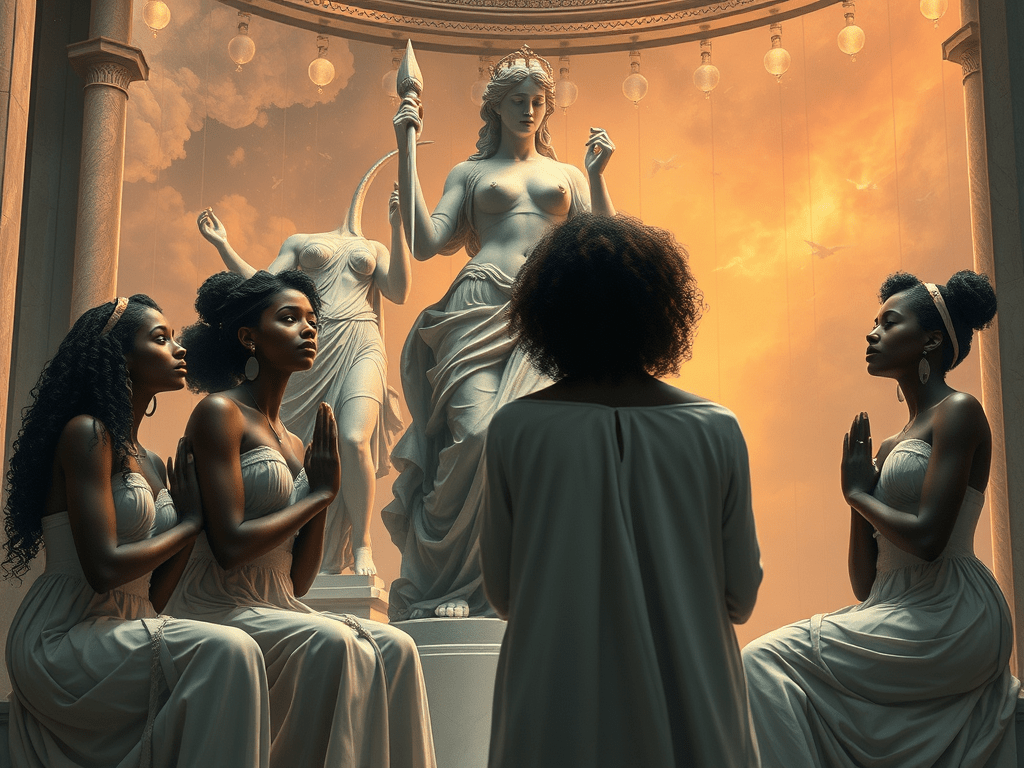
Ancient women built temples to the goddesses of love. It was devotion that was shaped by what women needed and feared and longed for. They longed for love, life long commitment and family. These deep longings did not die with the old religions. What simply shifted were the names of the gods and their overt worship, not the desires that once sustained them.
The old gods and the new
Aphrodite was the Greek goddess of love, beauty, desire, and sexual power. Women brought offerings to her temples praying for a husband, then praying to be beautiful enough to keep him. They prayed for the kind of love that would secure their place in the world. Hera was the goddess of marriage, family, and legitimate social standing. She was Zeus’s wife, which made her powerful. To honour Hera was to seek the dignity that came with the title “wife”, the kind of woman whose status was established, whose life was ordered, whose worth was visible for all to see.
Most Christian women do not even know who Aphrodite is. They would never enter Hera’s temple. They pray to God, read Scripture, attend church, and believe sincerely in Christ. This is not a question of one’s salvation, but rather of identity and misdirected longing? What does she believe God’s favour looks like. How can she tell one is blessed and what is definitive evidence that God is “on her side”.
Sadly in much of Christian culture (and the world really), marriage performs precisely the same function that it did for Aphrodite and Hera’s worshippers. It promises to make a woman’s life valuable and to establish her worth. The ring serves as confirmation that she has been chosen and her worth is secured. Marriage gives her access to a kind of social and spiritual legitimacy that singleness does not provide.
The altars were not demolished, merely renovated and given a facelift.
Romantic Idoltry
Idolatry is not always loud and look like burning incense and bowing at an altar. A Christian woman can confess Christ as Lord while her interior life is completely organised around the hope of romantic partnership. Her theology is orthodox. But her functional gospel, the one that actually governs her emotions, her prayers, her sense of God’s nearness, is romantic.
When a relationship begins, God is good. When a relationship ends, God feels distant. When a season of singleness stretches longer than expected, the questions that emerge are not merely emotional. They are theological. “Does God see me?” “Does He care?” “Why would He withhold this?” “What is wrong with me?”
These questions reveal what a woman actually believes God’s goodness looks like.
In the New Testament, singleness is not presented as a tragedy or a waiting room. Paul describes it as a gift, a form of freedom for undivided devotion to Christ. Jesus himself was single. He did not need marriage to fulfill all righteousness. The earliest Christian communities understood singleness as a legitimate, even honourable, mode of life. There was no confusion that salvation is not confirmed at the altar of marriage but at the cross. Christ alone justifies.
When singleness is treated as spiritual failure, or as evidence that a woman has somehow not yet been fully blessed, or as a condition requiring explanation, scripture is not being properly applied. It is telling women what the temples of Aphrodite told them: that their worth is located in being desired by a man, and their life is incomplete until it is.
The Desire Is Not the Problem
I want to be very careful here because this were things get tricky. The argument is not that romantic love is wrong, or that wanting marriage is a sign of spiritual immaturity. The desire for love, companionship, and family is woven into human nature and nothing to be ashamed of. Marriage is to be held in high honor. I myself prayed long and hard for my husband, and will gladly pray with any single ladies who desire it. The longing for it is not a failure of faith.
But there is a distinction, and it matters enormously, between a good desire held openly before God and a sacred need around which an entire identity and theological understanding is based.
Aphrodite’s worshippers did not love wrongly by wanting love. They positioned the desire in the wrong place. They gave it divine authority over their worth, their identity, and their sense of the world’s order. They built temples to it. They made it the thing that, if received, would finally make everything right.
When a desire becomes an ultimate, it becomes an idol. Because nothing finite can carry the weight of being someone’s god. Marriage cannot bear that weight. No mere husband can handle it.. I have been here for only five years, but trust me I know. The altar collapses under every person who builds it, not because they were unworthy, but because they asked the wrong thing to be the source of life.

Christ is Enough
Our worth is not conferred by marriage, desire, or being chosen, but is fixed in the unchanging truth that we are made in the image of God.
Christian theology makes a specific, non-negotiable claim: that human worth is not earned nor is it confirmed by relational status. Christ does not love the married woman more than He loves the single woman. He is not more pleased with a married woman simply becuase of her marital status. He is pleased when we lay aside our idols and look only to Him.
Christ alone is not a consolation prize for single women. It is the foundation of all Christian life, married or unmarried.
A woman whose identity is grounded in Christ does not need marriage to confirm that she has been seen. She does not experience God’s goodness as conditional on His delivering a particular relational outcome.
This is an invitation, not to suppress desire, but to surrender worship. To lay down our lives, abandon every altar we have built for love, security, or validation, and take up our cross to follow Christ alone. It is a call to trust that His plans are truly good, even when they look different from what we imagined, and to refuse anything that seeks to elevate itself to a place only God should occupy. In that laying down, we do not lose ourselves; we are finally freed to live, love, and hope without the weight of false gods.
 Gambiza's Corner
Leave a comment